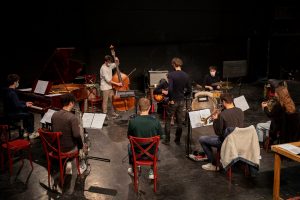
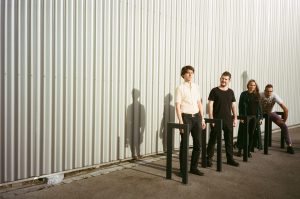
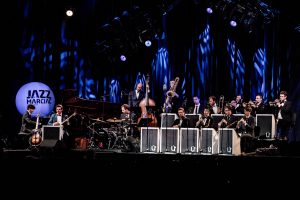
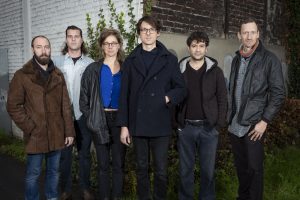
Fondé en 2011, l’orchestre de 14 virtuoses poursuit inlassablement, sous la direction de Pierre-Antoine Badaroux, un travail qui vise à mettre en avant les arrangeurs de la musique pour Big Band.
DU RÉPERTOIRE HISTORIQUE
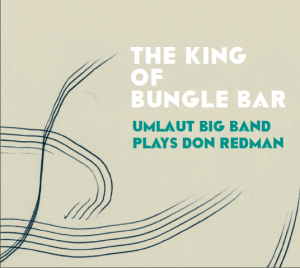
Depuis sa création, le groupe s’est principalement concentré sur le jazz des années 1920-1940, à travers la musique de Don Redman, Fletcher Henderson, Duke Ellington, Benny Carter et d’autres, mais aussi des musiciens européens. Il a développé un répertoire de plus de 200 morceaux et sortis 4 albums en 6 ans.
A l’instar de la démarche des orchestres de musique ancienne, la recherche historique effectuée à partir de partitions rares et d’enregistrements, a pour fondement l’intime conviction que les arrangeurs, rarement mis avant dans l’histoire du jazz, sont des créateurs qui sans cesse inventent de nouvelles formes.
Dans son interprétation, le groupe privilégie l’acoustique et les atmosphères chaleureuses et festives, aussi bien dans des salles de concerts que sur des places de villages.
À LA CRÉATION CONTEMPORAINE
Également très actifs sur la scène européenne des musiques improvisées et jazz, les musiciens ont souhaité élargir le répertoire de l’ensemble par une série de commandes à des compositeurs contemporains ayant un rapport intime avec le jazz.
Ainsi depuis 2016, le Umlaut Big Band a créé de nouvelles œuvres, d’abord écrites par des membres de l’orchestre (Pierre-Antoine Badaroux, Antonin Gerbal, Pierre Borel), puis par des compositeurs invités (Alexander Von Schlippenbach, Jean-Luc Guionnet, Axel Dörner, Bertrand Denzler et Joel Grip).
Trop rarement abordé par les compositeurs actuels, le format du Big Band se prête idéalement à des explorations sonores riches, dialogue entre une longue tradition liée au jazz et les formes d’invention contemporaines.
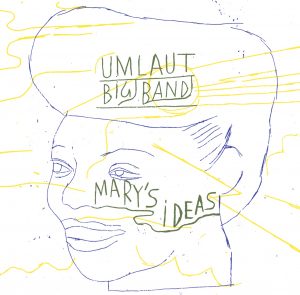
Mary’s Ideas création 2021-22
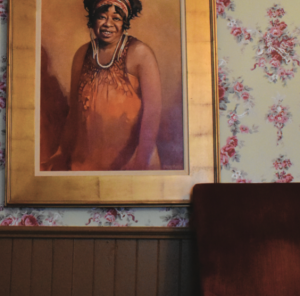
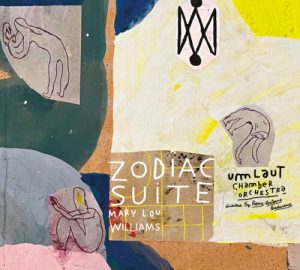
Après un travail sur Don Redman, le Umlaut Big Band poursuit sa série de portraits des compositeurs-arrangeurs de l’histoire du jazz en s’intéressant à l’oeuvre de Mary Lou Williams (1910-1981).
+ d’infos
Founded in 2011, the orchestra of 14 virtuosos, under the direction of Pierre-Antoine Badaroux, relentlessly pursues a work that aims to highlight the arrangers of music for big band.
FROM HISTORICAL REPERTOIRE
Since its creation, the band has been mainly focusing on the jazz from the 20’s to the 40’s, through the music of Don Redman, Fletcher Henderson, Duke Ellington, Benny Carter and others, as well as European musicians. The band has developed a repertory of over 200 tracks and released 4 records in 6 years.
In the manner of the orchestras of early music, the historical research carried out from rare scores and recordings, is based on the intimate conviction that the arrangers, oft-overlooked in the history of jazz, are creators who never stop inventing new forms.
In its performances, the band favors the acoustic as well as a warm and festive atmosphere, whether they are playing in a concert hall or on a village party: music is for all.
TO CONTEMPORARY CREATION
Also very active on the European stage of improvised musics and jazz, the musicians wanted to widen the band’s repertory with a series of commissions to contemporary composers who maintain an intimate relation with jazz.
And so since 2016, the Umlaut Big Band has created new pieces, first written by members of the orchestra (Pierre-Antoine Badaroux, Antonin Gerbal, Pierre Borel), then by invited composers (Alexander Von Schlippenbach, Jean-Luc Guionnet, Axel Dörner, Bertrand Denzler and Joel Grip).
Too rarely tackled by composers in our days, the form of the big band is ideal for rich sound explorations, and starting a dialogue between a long tradition linked to jazz and the forms of contemporary inventions: music beyong genre.
Mary’s Ideas – new repertoire 2021-22
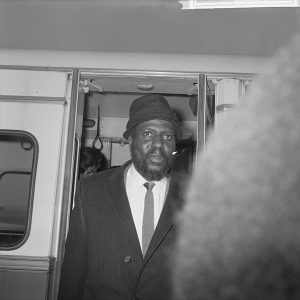
Mary Lou Williams (1910-1981) is a pianist, composer and arranger. Pianist on stage and arranger in the shadows for Andy Kirk’s orchestra from the 1930s on, she aroused the curiosity of the public, because there were very few female instrumentalists in jazz. In the 1940s, she became the mentor of Thelonious Monk, Bud Powell and Dizzy Gillespie. During this period, she wrote for Duke Ellington and Benny Goodman, and collaborated with Cecil Taylor and Buster Williams in the 1970s. When she died in 1981, she left unfinished an ambitious suite relating the history of jazz.
more infos
Musiciens
Pierre-Antoine Badaroux – direction, saxophone alto
Antonin Tri-Hoang, saxophone alto et clarinette
Benjamin Dousteyssier – saxophone baryton et alto
Geoffroy Gesser – saxophone ténor et clarinette
Pierre Borel – saxophone ténor et clarinette
Pauline Leblond, trompette
Brices Pichard, trompette
Emil Strandberg, trompette
Fidel Fourneyron, trombone
Mickaël Ballue, trombone
Sébastien Beliah, contrebasse
Romain Vuillemin, guitare
Mathieu Naulleau, piano
Antonin Gerbal, batterie
Musicians
Pierre-Antoine Badaroux – direction, alto saxophone
Antonin Tri-Hoang, alto saxophone & clarinet
Benjamin Dousteyssier – baryton & alto saxophone
Geoffroy Gesser – tenor saxophone & clarinet
Pierre Borel – tenor saxophone & clarinet
Pauline Leblond, trumpet
Brices Pichard, trumpet
Emil Strandberg, trumpet
Fidel Fourneyron, trombone
Mickaël Ballue, trombone
Sébastien Beliah, doublebass
Romain Vuillemin, guitar
Mathieu Naulleau, piano
Antonin Gerbal, drums
Presse
« Si la démarche musicologique est des plus sérieuses, elle est transcendée par l’irrésistible fièvre de danser que ce big band s’applique à communiquer »
– Les Inrockuptbiles



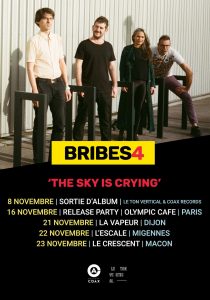













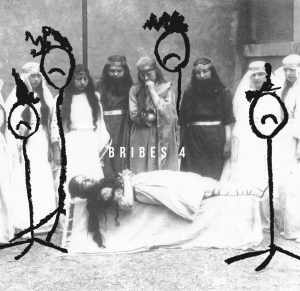
 “[la musique de Bribes 4] garde étonnamment une certaine sensualité éthérée qui flotte dans la pénombre inquiétante d’une musique lancinante capable d’exploser à chaque instant.”
 “En glissant de Bribes à Bribes 4, le duo est passé du court au moyen métrage : tout est plus grand, plus fort, plus haut.”
 “Bribes 4 c’est un peu un creuset dans lequel on peut toujours trouver des choses neuves”